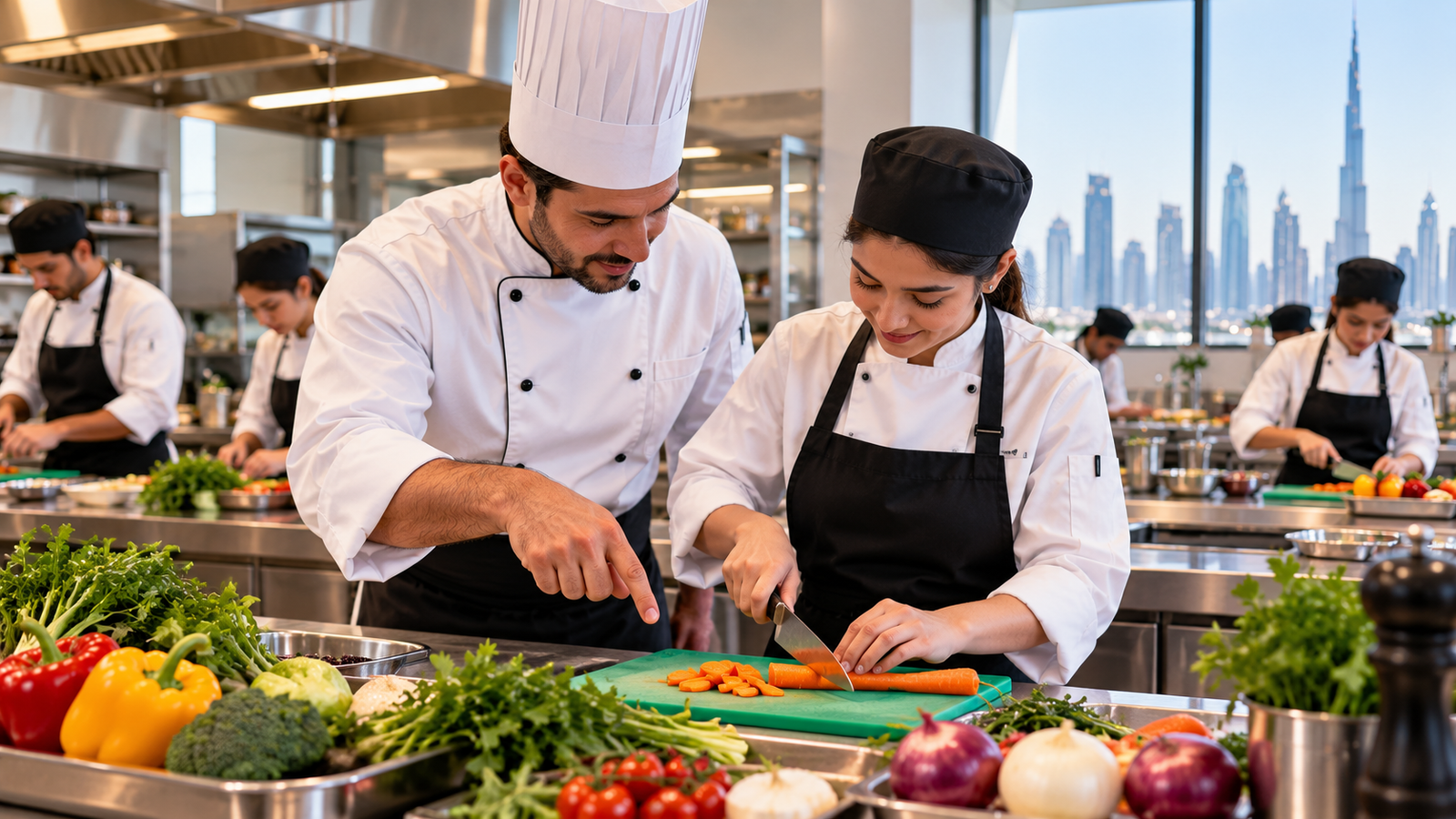
Chef Interview Questions and Answers in Dubai: Top 20 Questions for Beginners and Professionals
Preparing for a chef interview in Dubai requires knowledge of cooking techniques, food safety, professional kitchen operations, teamwork, and time management. Common chef interview questions include "Tell me about yourself," "What is mise en place?", "How do you maintain food hygiene?", and "How do you handle pressure during busy kitchen service?"
Employers may also assess candidates through practical cooking tests to evaluate food preparation, knife skills, recipe execution, and presentation.
Whether you are applying for a Commis Chef, Chef de Partie, Sous Chef, or Executive Chef position, preparing professional answers can improve your confidence and interview performance.
This guide provides 20 chef interview questions and sample answers, technical preparation advice, and practical tips for culinary job interviews in Dubai and the UAE.
What Do Employers Look for During Chef Interviews in Dubai?
Hotels, restaurants, catering companies, and hospitality businesses evaluate candidates according to their technical skills, experience, and professional behavior.
Employers commonly assess the following areas:
- Cooking techniques: Knowledge of preparation methods, recipes, ingredients, and food presentation.
- Food safety: Understanding hygiene procedures, cross-contamination prevention, temperature control, and HACCP principles.
- Kitchen organization: Ability to prepare ingredients, manage equipment, and maintain an efficient workstation.
- Time management: Capacity to complete tasks accurately during busy service periods.
- Teamwork: Ability to communicate and cooperate with other kitchen professionals.
- Problem-solving: Responding appropriately to ingredient shortages, cooking mistakes, and unexpected situations.
- Leadership: Supervising employees, controlling costs, and managing operations in senior culinary positions.
Preparing examples that demonstrate these skills can help candidates present their qualifications effectively.
Common Chef Interview Questions and Answers
The following questions are suitable for culinary beginners and experienced professionals.
The sample responses should be adapted to reflect your actual qualifications, training, and experience.
1. Tell Me About Yourself.
Sample Answer:
"I am passionate about professional cooking and developing my culinary skills. I have completed culinary training where I learned food preparation, essential cooking techniques, kitchen hygiene, and recipe execution. I enjoy working in organized environments and collaborating with kitchen teams. My goal is to gain professional experience and develop a successful career in the hospitality industry."
Interview Tip: Keep your introduction focused on your qualifications, relevant experience, strongest skills, and career goals.
2. Why Do You Want to Become a Chef?
Sample Answer:
"I want to become a chef because I enjoy preparing food, learning new cooking techniques, and creating enjoyable dining experiences. Professional cooking combines creativity, discipline, and teamwork. I am interested in developing my technical knowledge and working with experienced chefs who can help me improve my abilities."
Interview Tip: Explain your motivation while demonstrating that you understand the demands of professional kitchen work.
3. Why Should We Hire You as a Chef?
Sample Answer:
"I can contribute practical cooking knowledge, strong organizational skills, and a willingness to learn. I understand the importance of food safety, following standardized recipes, and maintaining consistent quality. I take instructions seriously, work well with others, and remain focused during demanding situations."
Interview Tip: Mention skills that match the job description rather than making unsupported claims about your abilities.
4. How Do You Handle Pressure During Busy Kitchen Service?
Sample Answer:
"I handle pressure by organizing my workstation, preparing ingredients before service, and prioritizing tasks. I communicate with my team, follow kitchen procedures, and focus on maintaining food quality. If an unexpected problem occurs, I inform the appropriate supervisor and work toward a practical solution without compromising food safety."
Interview Tip: Experienced candidates should support their answer with a real workplace example.
5. Why Do You Want to Work in Our Restaurant or Hotel?
Sample Answer:
"I am interested in your establishment because of its culinary concept, professional standards, and opportunities for skill development. I have reviewed your menu and understand the type of dining experience you provide. I believe my culinary abilities and willingness to learn would allow me to contribute positively to your kitchen team."
Interview Tip: Research the employer's cuisine, menu, service style, and reputation before attending the interview.
Technical Chef Interview Questions and Answers
Technical questions help employers evaluate whether candidates understand essential cooking methods and professional kitchen procedures.
6. What Is Mise en Place in Cooking?
Sample Answer:
"Mise en place is a French culinary term meaning 'everything in its place.' It refers to preparing and organizing ingredients, utensils, and equipment before cooking begins. This process helps chefs work efficiently, maintain consistency, and reduce delays during service. Proper mise en place is essential for organized professional kitchen operations."
Interview Tip: Explain how you use mise en place during preparation and service.
7. What Are the Five Mother Sauces?
Sample Answer:
"The five classical French mother sauces are Béchamel, Velouté, Espagnole, Tomato, and Hollandaise. These sauces provide foundations for many traditional preparations. Béchamel is milk-based, Velouté uses light stock, Espagnole is a brown sauce, Tomato is tomato-based, and Hollandaise is an emulsion of egg yolks and clarified butter."
Interview Tip: Practice preparing basic sauces and explaining how derivative sauces are developed.
8. How Do You Maintain Food Safety in a Professional Kitchen?
Sample Answer:
"I maintain food safety by following personal hygiene procedures, washing my hands correctly, preventing cross-contamination, and storing ingredients at appropriate temperatures. I separate raw and ready-to-eat foods, use clean equipment, monitor temperature requirements, and follow the establishment's approved food safety procedures."
In Dubai, employers must follow applicable food safety requirements overseen by Dubai Municipality.

9. What Is HACCP and Why Is It Important?
Sample Answer:
"HACCP stands for Hazard Analysis and Critical Control Points. It is a systematic approach to identifying and controlling significant food safety hazards. These hazards may be biological, chemical, or physical. HACCP principles help food businesses establish preventive controls, monitoring procedures, corrective actions, and appropriate records to support safe food production."
Interview Tip: Be prepared to explain practical examples of temperature monitoring, cleaning procedures, and preventing contamination.
10. How Do You Prevent Cross-Contamination?
Sample Answer:
"I prevent cross-contamination by keeping raw and ready-to-eat foods separate, using appropriate utensils and equipment, cleaning and sanitizing work surfaces, and washing hands between tasks. I also follow safe food storage procedures and the kitchen's allergen management system."
For example, equipment used to prepare raw chicken must be appropriately cleaned and sanitized before being used for ready-to-eat ingredients.
11. What Would You Do If a Customer Had a Food Allergy?
Sample Answer:
"I would confirm the customer's allergy information through the approved communication process and check the ingredients, recipes, and potential cross-contact risks. I would inform the responsible chef and follow the establishment's allergen procedures. If the kitchen cannot prepare the dish safely, I would communicate that concern rather than make assumptions."
Interview Tip: Never claim that removing a visible ingredient automatically makes a dish allergen-free.
Commis Chef Interview Questions and Answers
Commis Chef interviews focus on fundamental cooking techniques, food hygiene, following instructions, and supporting kitchen operations.
12. What Are the Main Responsibilities of a Commis Chef?
Sample Answer:
"A Commis Chef assists senior chefs with ingredient preparation, basic cooking tasks, workstation organization, and cleaning. Responsibilities include following recipes, preparing vegetables and proteins, checking ingredient quality, and maintaining hygiene. A Commis Chef must also communicate effectively, follow instructions, and support smooth kitchen operations."
Interview Tip: Emphasize reliability, attention to detail, and willingness to learn.
13. How Would You Handle a Cooking Mistake?
Sample Answer:
"If I made a cooking mistake, I would immediately assess the situation and inform my supervisor when necessary. I would not serve food that fails quality or safety requirements. I would correct the issue using approved procedures, understand what caused the mistake, and take steps to prevent it from happening again."
Interview Tip: Employers value accountability and safe decision-making.
Chef de Partie Interview Questions and Answers
Chef de Partie interview questions usually assess station management, food consistency, production planning, and junior staff supervision.
14. How Do You Manage Your Kitchen Station?
Sample Answer:
"I manage my station by checking ingredients, reviewing preparation requirements, organizing mise en place, and ensuring equipment is ready. I monitor stock levels, maintain food safety standards, and coordinate with other kitchen sections. During service, I focus on accurate order preparation, communication, and consistent presentation."
Interview Tip: Explain your preparation checklist and how you prioritize tasks during service.
15. How Do You Maintain Food Quality and Consistency?
Sample Answer:
"I maintain consistency by following standardized recipes, controlling ingredient quantities, using correct cooking techniques, and checking presentation before service. I also monitor temperatures, supervise preparation, and provide feedback to junior employees. Regular quality checks help ensure dishes meet the establishment's standards."
Interview Tip: Give an example of how you improved consistency or reduced preparation errors.
Sous Chef Interview Questions and Answers
Sous Chef positions require technical expertise, supervision, problem-solving, and operational coordination.
16. How Do You Manage a Kitchen Team During Busy Service?
Sample Answer:
"I begin by reviewing reservations or expected service volume, checking preparation readiness, and assigning responsibilities. During service, I monitor kitchen operations, communicate priorities, and support stations experiencing difficulties. If staffing becomes insufficient, I reorganize tasks according to employee abilities while maintaining food safety and service standards."
Interview Tip: Show that you can make practical decisions without sacrificing quality or employee safety.
17. How Would You Handle Conflict Between Kitchen Employees?
Sample Answer:
"I would address the situation professionally and prevent the disagreement from disrupting service. I would listen to the employees involved, identify the cause, and reinforce appropriate workplace expectations. If necessary, I would involve senior management and follow company procedures. My priority would be maintaining respectful communication and effective teamwork."
Interview Tip: Demonstrate fairness, professionalism, and leadership.
Executive Chef Interview Questions and Answers
Executive Chef interviews focus on culinary strategy, financial management, staff development, menu planning, and operational performance.
18. How Do You Control Food Costs in a Professional Kitchen?
Sample Answer:
"I control food costs through accurate recipe costing, portion control, stock monitoring, responsible purchasing, and waste reduction. I review ingredient prices, analyze menu performance, and compare actual costs against targets. I also train employees to follow standardized recipes and proper inventory procedures."
Example:
If ingredients cost AED 20 and the menu selling price is AED 80:
Food Cost Percentage = (20 ÷ 80) × 100 = 25%
This represents the ingredient cost percentage of the dish, excluding labor and other operating expenses.
19. How Do You Develop a Successful Restaurant Menu?
Sample Answer:
"I develop menus by considering the restaurant concept, target customers, ingredient availability, kitchen capabilities, and profitability. I test recipes, calculate costs, establish portions, and evaluate presentation. I also review customer feedback and sales performance to improve menu quality and commercial results."
Interview Tip: Prepare examples of menus you have developed or contributed to, including measurable results where available.
20. How Do You Lead and Develop a Professional Kitchen Team?
Sample Answer:
"I focus on clear responsibilities, practical training, constructive feedback, and consistent professional standards. I evaluate employees' strengths, identify development needs, and create opportunities to learn additional kitchen skills. I also monitor operational performance, support supervisors, and encourage communication between culinary departments."
Interview Tip: Executive Chef candidates should provide examples of staff development, improved kitchen performance, or successful operational changes.
How to Prepare for a Practical Chef Interview Test in Dubai
Some hotel and restaurant employers require a practical cooking assessment before making a hiring decision.
The purpose is to evaluate your ability to apply culinary knowledge in a professional environment.
A practical assessment may include preparing a dish, demonstrating knife skills, cooking a protein correctly, producing a sauce, or organizing a kitchen station.
Skills Employers May Evaluate
| Practical SkillWhat the Employer Checks | |
| Knife techniques | Safety, precision, and consistency |
| Mise en place | Preparation and organization |
| Cooking methods | Technical accuracy |
| Food hygiene | Safe preparation procedures |
| Time management | Efficient task completion |
| Flavor and seasoning | Quality and balance |
| Food presentation | Plating and attention to detail |
| Team communication | Professional workplace behavior |
Before the assessment, confirm the task requirements and available equipment.
During the test, maintain a clean workstation, follow appropriate safety practices, communicate professionally, and check food quality before presenting the dish.
How to Prepare for a Chef Interview in Dubai
Successful professional chef interview preparation requires technical revision, employer research, and confident communication.
Research the Restaurant or Hotel
Review the establishment's cuisine, menu, service style, and customer expectations.
This helps you explain why you are interested in the position.
Review Essential Culinary Knowledge
Practice explaining cooking techniques, mother sauces, food hygiene, preparation methods, and kitchen organization.
Senior candidates should also review costing, inventory management, and supervisory responsibilities.
Prepare Your Professional Documents
Bring an updated resume, relevant culinary certificates, and any documents requested by the employer.
A culinary portfolio containing photographs of dishes and descriptions of your practical skills can also support your application.
Practice Interview Answers
Prepare examples demonstrating teamwork, problem-solving, time management, and professional development.
For behavioral questions, use the STAR method: Situation, Task, Action, and Result.
Explain what happened, what you needed to accomplish, what you personally did, and the outcome.
Demonstrate a Professional Attitude
Arrive punctually, dress appropriately, communicate respectfully, and answer questions clearly.
If you do not know an answer, acknowledge the limitation and explain how you would verify the correct procedure.
Honest and accurate responses are more valuable than memorized answers that misrepresent your experience.
Common Mistakes to Avoid During Chef Interviews
Candidates sometimes make avoidable mistakes that affect their interview performance.
- Giving vague answers without practical examples.
- Claiming experience or qualifications they do not possess.
- Demonstrating poor food safety awareness.
- Failing to research the employer's culinary concept.
- Ignoring teamwork and communication skills.
- Arriving unprepared for a possible cooking assessment.
- Focusing only on salary without understanding job responsibilities.
Preparing carefully and demonstrating professional judgment can help candidates create a stronger impression.
Frequently Asked Questions About Chef Interviews in Dubai
1. What Are the Most Common Chef Interview Questions?
Common chef interview questions cover cooking experience, kitchen organization, food safety, teamwork, and handling busy service. Employers may also ask about mise en place, HACCP, mother sauces, ingredient storage, and recipe consistency. The exact questions depend on the position, culinary specialization, and responsibilities.
2. How Can Freshers Prepare for a Chef Interview?
Freshers should revise essential cooking techniques, knife skills, ingredient preparation, food hygiene, and kitchen terminology. They should also prepare a short introduction highlighting culinary training and practical experience. Candidates without employment experience can discuss supervised cooking exercises, training assessments, and their willingness to learn.
3. What Questions Are Asked During a Hotel Chef Interview?
Hotel chef interviews may include questions about food preparation, kitchen hygiene, standardized recipes, buffet operations, and teamwork. Senior candidates may face questions about inventory, staffing, food costs, and quality control. Some hotels also conduct cooking assessments to evaluate candidates' practical abilities.
4. What Should I Wear to a Chef Interview in Dubai?
For a conventional interview, clean and professional business attire is usually appropriate unless the employer specifies otherwise. If a cooking assessment is scheduled, confirm whether chef whites, kitchen shoes, or other protective clothing are required. Follow the establishment's safety and hygiene instructions.
5. How Do I Answer Chef Interview Questions Without Experience?
Focus on relevant culinary education, supervised practice, cooking techniques, and transferable skills. Explain how you follow instructions, maintain hygiene, organize ingredients, and work with others. Avoid claiming professional experience you do not have. Instead, demonstrate enthusiasm, technical understanding, and readiness to develop practical kitchen skills.
6. What Technical Questions Should I Study Before a Chef Interview?
Study cooking methods, knife cuts, mother sauces, kitchen terminology, food storage, cross-contamination prevention, allergen handling, and HACCP fundamentals. Candidates applying for supervisory positions should also understand recipe costing, stock rotation, inventory management, production planning, and maintaining quality during high-volume kitchen operations.
7. How Should I Answer Salary Expectation Questions?
Research typical compensation for your position and experience level before attending the interview. Provide a realistic range and clarify whether it refers to basic salary or the total package. In Dubai, candidates should also consider contractual working hours, accommodation, transportation, meals, and other employment benefits.
8. Can Culinary Training Help Me Pass a Chef Interview?
Culinary training can help candidates prepare by developing professional cooking techniques, food safety knowledge, kitchen organization, and practical confidence. Structured practice may also improve performance during cooking assessments. However, interview success depends on preparation, demonstrated ability, communication, relevant qualifications, and individual employer requirements.
Conclusion: Prepare Confidently for Your Next Chef Interview
Chef interviews in Dubai evaluate more than cooking ability. Employers look for candidates who understand food safety, professional kitchen procedures, teamwork, and the responsibilities of their chosen positions.
Beginners should focus on fundamental cooking knowledge, hygiene, and a willingness to learn. Experienced chefs should demonstrate practical achievements, leadership abilities, and operational understanding.
By practicing these 20 chef interview questions and answers, reviewing technical culinary concepts, and preparing for practical cooking assessments, you can approach your next interview with greater confidence.
Successful chef interview preparation combines culinary knowledge, genuine experience, professional communication, and the ability to demonstrate your skills in a real kitchen environment.