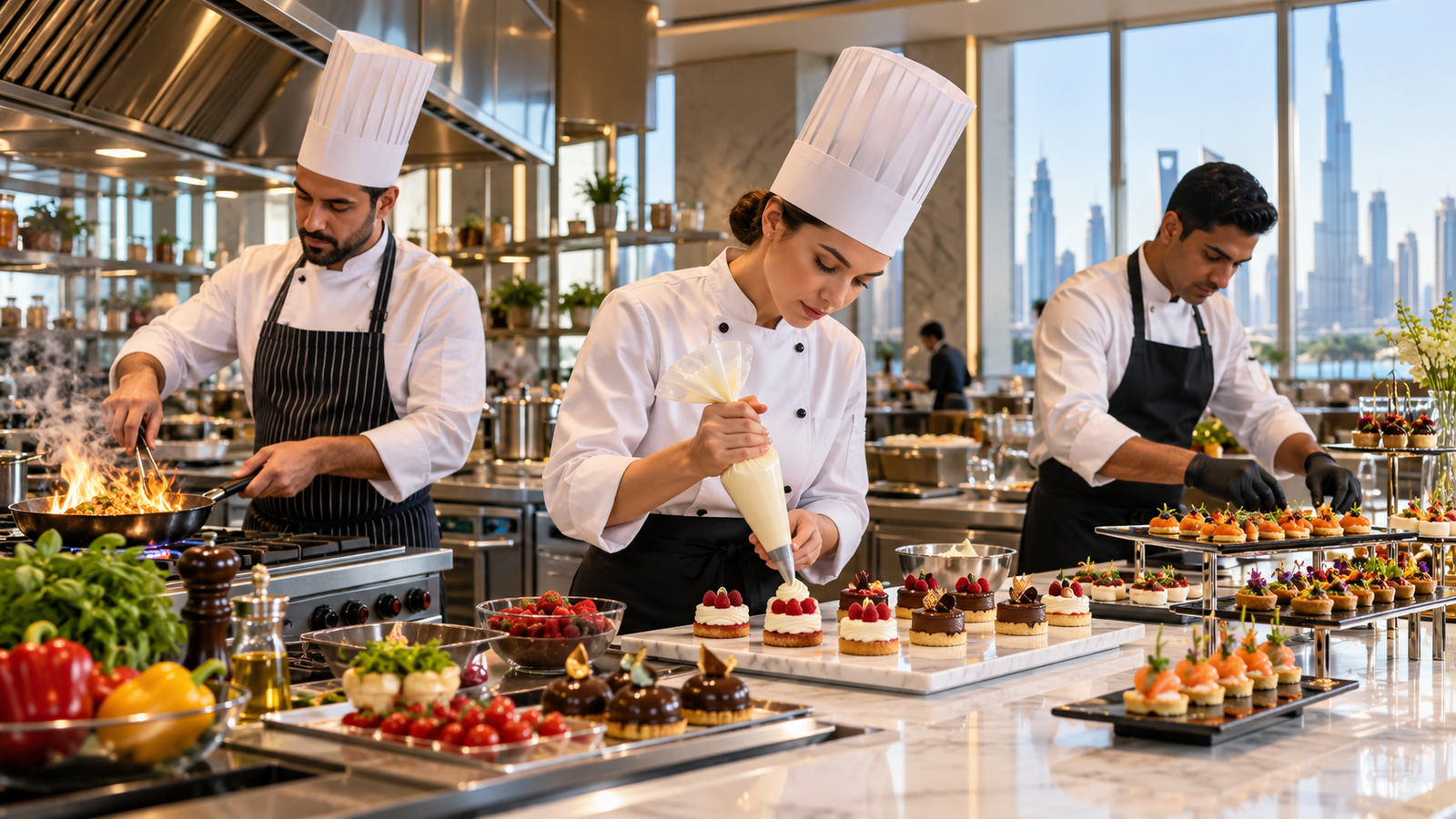
How Culinary Training Helps You Get a Job in Dubai: Complete Career Guide
Culinary training helps you get a job in Dubai by developing practical cooking skills, food safety knowledge, professional kitchen discipline, and the technical abilities employers expect from entry-level chefs. Professional culinary courses prepare beginners for positions such as Commis Chef, Kitchen Assistant, Line Cook, and Pastry Assistant in hotels, restaurants, and catering companies.
Through hands-on cooking practice, students learn food preparation, kitchen equipment handling, hygiene procedures, recipe execution, and teamwork. These skills can improve employability and prepare graduates for professional kitchen assessments.
However, culinary training is the beginning of career development. Securing employment also depends on practical ability, qualifications, experience, available vacancies, and employer requirements.
Why Is Culinary Training Important for Getting a Job in Dubai?
Culinary training is important because professional kitchens require more than basic home cooking abilities.
Employers need workers who can prepare food consistently, follow standardized recipes, maintain hygiene, and perform effectively during busy service periods.
Dubai's hospitality industry includes luxury hotels, international restaurants, cafés, catering businesses, bakeries, and large food production operations.
These establishments employ culinary professionals with different specializations and experience levels.
Structured professional chef training in Dubai helps beginners understand the standards and responsibilities of a commercial kitchen.
Instead of learning every technique independently, students receive organized instruction in essential culinary methods and professional working practices.
For job seekers without previous kitchen experience, this preparation can make the transition into hospitality employment easier.
How Does Culinary Training Help You Get a Job?
Culinary education improves employment readiness by combining technical knowledge, supervised practice, food safety awareness, and professional workplace skills.
1. Develops Practical Cooking Skills Employers Need
One of the biggest benefits of culinary training in Dubai is learning cooking techniques used in commercial kitchens.
Students practice essential methods such as boiling, steaming, frying, grilling, roasting, baking, and sautéing.
They also develop knife skills, ingredient preparation techniques, and an understanding of cooking temperatures.
For example, a trainee may learn to prepare vegetables using consistent cuts, cook proteins to appropriate temperatures, and present a dish according to a standardized recipe.
These abilities are valuable because employers expect junior chefs to perform basic preparation tasks accurately.
Regular hands-on practice also improves speed, consistency, and confidence.
2. Provides Professional Kitchen Experience
Professional kitchen training introduces students to commercial equipment and workplace procedures.
Students may practice using industrial ovens, stovetops, food processors, mixers, refrigeration systems, and specialized cooking tools.
They also learn mise en place, a French culinary term referring to preparing and organizing ingredients and equipment before cooking begins.
For example, a trainee preparing for lunch service may organize vegetables, portion ingredients, prepare sauces, and check equipment before receiving orders.
Understanding this process helps new employees adapt to structured kitchen operations.
Although training kitchens cannot replace real restaurant experience, they provide useful preparation for entry-level employment.
3. Teaches Food Safety and Hygiene Standards
Food safety is an essential responsibility in the food and beverage industry.
Professional culinary training introduces students to safe food handling, personal hygiene, cleaning procedures, temperature control, and cross-contamination prevention.
Students learn why raw ingredients must be handled carefully, how food should be stored, and why allergen awareness matters.
Dubai food establishments operate under applicable food safety requirements supervised by Dubai Municipality.
Employers may require employees to complete recognized food hygiene training appropriate to their responsibilities.
Understanding food safety principles during culinary education helps graduates prepare for these workplace expectations.
4. Builds Confidence for Practical Cooking Interviews
Many hospitality employers assess candidates through interviews or practical cooking demonstrations.
A practical assessment may involve preparing ingredients, demonstrating knife techniques, following a recipe, or producing a dish within a specified time.
Culinary training helps students become familiar with these activities.
For example, an employer may ask a Commis Chef candidate to demonstrate vegetable cutting, prepare a basic sauce, or explain safe food storage procedures.
Students who have practiced these tasks under instructor supervision may feel more prepared during assessments.
Confidence supported by demonstrated skills can create a stronger impression on potential employers.
5. Improves Teamwork and Communication
A professional kitchen depends on coordination between chefs, kitchen assistants, supervisors, and service employees.
Culinary students learn to follow instructions, communicate clearly, manage assigned tasks, and cooperate with others.
During practical training, students may work together to prepare several dishes for a simulated restaurant service.
Each person must complete their responsibilities while coordinating with the rest of the team.
This develops workplace communication and organizational habits.
Teamwork is particularly valuable in Dubai, where hospitality businesses often employ professionals from different cultural and linguistic backgrounds.
6. Develops Time Management and Work Discipline
Commercial kitchens operate under strict preparation and service schedules.
Chefs must organize ingredients, prioritize cooking tasks, and complete orders without compromising food quality.
Culinary training introduces students to structured preparation routines and time-limited cooking exercises.
For example, preparing a complete meal within a specified period helps students understand task sequencing and efficient equipment use.
Regular practice can also develop punctuality, cleanliness, attention to detail, and accountability.
These professional habits are important for maintaining consistent performance in hotel and restaurant kitchens.
What Culinary Skills Are Required for Employment in Dubai?
Employers commonly look for candidates who understand cooking fundamentals and can apply them safely in professional environments.
The following skills support culinary employment readiness.
| Culinary SkillImportance for Employment | |
| Knife skills | Efficient and consistent ingredient preparation |
| Cooking techniques | Preparing dishes using appropriate methods |
| Food safety | Preventing contamination and unsafe handling |
| Recipe execution | Maintaining consistent taste and presentation |
| Mise en place | Organizing preparation before service |
| Time management | Completing kitchen tasks efficiently |
| Teamwork | Coordinating with kitchen employees |
| Portion control | Managing serving consistency and food costs |
| Equipment handling | Operating kitchen tools safely |
| Food presentation | Meeting established plating standards |
Professional culinary courses help learners develop these skills through demonstrations, supervised exercises, and practical assessments.
Employers may also value adaptability, physical stamina, communication ability, and a willingness to learn.
What Jobs Can You Get After Culinary Training in Dubai?
Culinary arts career opportunities in the UAE include several entry-level and specialized positions.
The most suitable job depends on a graduate's skills, practical experience, and career interests.
1. Commis Chef
A Commis Chef assists experienced chefs with ingredient preparation, basic cooking, cleaning, and kitchen organization.
This is a common starting position for culinary graduates interested in hotel and restaurant careers.
With experience, Commis Chefs may progress to Demi Chef de Partie and Chef de Partie positions.
2. Kitchen Assistant
Kitchen Assistants support food preparation, ingredient handling, cleanliness, and equipment organization.
This position can help beginners understand professional kitchen operations before taking on more advanced cooking responsibilities.
It may be suitable for candidates who have completed basic culinary training but need additional workplace experience.
3. Line Cook
Line Cooks prepare dishes at designated kitchen stations during restaurant service.
They must understand recipe execution, portion control, cooking temperatures, and workplace efficiency.
Graduates interested in restaurant kitchen operations may pursue junior line cooking opportunities after developing the relevant practical skills.
4. Pastry Assistant
Pastry Assistants support the preparation of cakes, desserts, breads, pastries, and other baked products.
Specialized pastry training helps graduates develop measuring, mixing, baking, decorating, and presentation techniques.
Career development may lead toward Commis Pastry Chef, Chef de Partie Pastry, or senior pastry positions.

5. Catering Kitchen Assistant
Catering businesses prepare food for corporate events, weddings, celebrations, and other functions.
Entry-level catering employees assist with ingredient preparation, food production, portioning, and maintaining hygiene.
This career can provide experience in organized, large-scale food preparation.
6. Hotel Kitchen Trainee
Hotel kitchen trainee positions provide exposure to structured culinary departments.
Depending on the employer, trainees may gain experience in hot kitchens, cold kitchens, banquet operations, or pastry sections.
Some employers offer organized training programs, while others recruit junior kitchen employees directly.
7. Bakery Assistant
Bakery Assistants support bread and pastry preparation, ingredient measurement, mixing, baking, and product finishing.
This career path is appropriate for individuals interested in professional baking rather than general restaurant cooking.
Specialized training can help graduates build the foundational skills needed for bakery employment.
How Does Culinary School Prepare You for Hotel and Restaurant Jobs?
Culinary school helps students understand how professional kitchens are organized and how cooking tasks are performed according to established standards.
Hotel and restaurant kitchens often use standardized recipes, designated preparation stations, ingredient control procedures, and strict food safety practices.
Students who encounter these systems during training may adapt more easily when entering their first job.
Preparation for Hotel Kitchen Jobs
Hotel kitchens may prepare food for restaurants, banquets, buffets, and room service.
Training in preparation techniques, standardized recipes, and large-volume production can support entry-level hotel kitchen applications.
Preparation for Restaurant Kitchen Jobs
Restaurant kitchens require consistent food preparation, efficient order handling, and coordinated service.
Practical training in cooking techniques, presentation, and time management prepares students for these demands.
Preparation for Bakery and Pastry Jobs
Bakeries and pastry departments require accurate ingredient measurements, specialized preparation methods, and attention to detail.
Students who complete relevant baking and pastry training can develop skills suited to junior positions in these departments.
How to Get a Chef Job in Dubai After Culinary Training
Completing professional training is an important first step, but candidates must also prepare effectively for the recruitment process.
Step 1: Complete a Practical Culinary Course
Choose a training program that includes supervised cooking practice, professional kitchen equipment, food hygiene, and essential cooking techniques.
Review the syllabus to ensure it matches your desired career.
Step 2: Build a Culinary Portfolio
Create a portfolio showing dishes you have prepared during training.
Include clear photographs, dish descriptions, cooking techniques, and any relevant practical achievements.
A professional portfolio can demonstrate preparation skills and presentation standards.
Step 3: Prepare a Professional Chef Resume
Highlight culinary qualifications, cooking skills, food safety knowledge, practical assessments, and previous experience.
For beginners, include relevant training projects and kitchen practice.
Keep the resume concise and tailor it to the position.
Step 4: Apply for Suitable Entry-Level Jobs
Search for opportunities such as Kitchen Trainee, Commis Chef, Kitchen Assistant, Prep Cook, and Pastry Assistant.
Review employer requirements carefully because some junior positions still require previous kitchen experience.
Step 5: Prepare for Interviews and Cooking Trials
Practice basic techniques and prepare to explain cooking methods, hygiene procedures, and kitchen responsibilities.
During assessments, demonstrate organization, cleanliness, time management, and willingness to follow instructions.
A successful assessment can help employers evaluate your practical abilities.
Step 6: Review Employment Requirements
Candidates must ensure they have appropriate authorization to work in the UAE.
Employers generally arrange the relevant work permit process according to applicable regulations.
A culinary certificate does not replace legal employment authorization or any required workplace-specific food safety training.
Is Culinary Certification Important for Chef Jobs in Dubai?
A culinary certificate can support employment applications by demonstrating that a student has completed a structured training program.
However, not every culinary position requires the same qualification.
Some employers prefer culinary diplomas, while others consider practical experience, demonstrated cooking ability, and equivalent training.
For example, a recent Dubai hotel Commis Chef vacancy identified a culinary diploma as preferred while also requiring relevant kitchen skills and experience.
Candidates should understand the difference between a course completion certificate, an accredited culinary qualification, and required food safety certification.
These credentials serve different purposes and are not automatically interchangeable.
When selecting a course, verify the training provider's approval status, qualification details, practical training content, and assessment methods.
How to Choose Culinary Courses With Job Opportunities in Dubai
Students looking for culinary courses with job opportunities should evaluate training quality and career preparation rather than relying only on promotional claims.
A suitable program should provide practical kitchen experience, instruction in professional techniques, and opportunities to demonstrate competency.
It is also useful to ask whether the provider offers resume guidance, interview preparation, internships, or introductions to potential employers.
Importantly, career assistance is not the same as guaranteed job placement.
Before enrolling, students should confirm whether any advertised internship or placement arrangement is included in the course fee and whether participation depends on eligibility.
Choosing training that matches employer expectations can improve career readiness.
How Does Culinary Training Support Long-Term Career Development?
The benefits of culinary training continue beyond the first job.
As professionals gain kitchen experience, they may specialize in international cuisines, pastry, bakery, catering, or food production.
A typical chef career progression may follow this structure:
Kitchen Trainee → Commis Chef → Demi Chef de Partie → Chef de Partie → Sous Chef → Head Chef → Executive Chef
Advancement depends on technical expertise, professional experience, leadership ability, and available opportunities.
Senior chefs also need skills in staff supervision, menu planning, stock management, food costing, and kitchen budgeting.
Continuing professional development can help chefs prepare for these responsibilities.
Frequently Asked Questions About Culinary Training and Employment
1. Does culinary training help you get a job in Dubai?
Yes. Culinary training can improve employment readiness by developing cooking techniques, food safety knowledge, teamwork, and professional kitchen skills. Graduates may apply for suitable junior roles in hotels, restaurants, bakeries, and catering companies. However, training does not guarantee employment, and employers may require additional qualifications or experience.
2. Can I get a chef job in Dubai without experience?
Beginners can apply for selected trainee and junior kitchen positions, although requirements vary by employer. Culinary training can help candidates demonstrate practical abilities when they have limited professional experience. Developing knife skills, food preparation techniques, hygiene knowledge, and a professional portfolio can strengthen an application.
3. What is the best culinary course for beginners in Dubai?
A suitable beginner culinary course should cover knife skills, essential cooking techniques, ingredient preparation, kitchen hygiene, equipment handling, and practical recipe execution. The best choice depends on whether the student wants to work in restaurants, hotels, bakeries, or pastry departments. Practical training should be a major consideration.
4. Is a culinary certificate enough to become a chef?
A culinary certificate can help demonstrate foundational training, but it does not automatically qualify someone for every chef position. Employers may assess cooking ability, kitchen experience, food safety knowledge, and communication skills. Higher-level positions generally require substantial professional experience and additional leadership responsibilities.
5. What are the benefits of culinary training in Dubai?
Culinary training provides structured instruction in professional cooking methods, food safety, equipment handling, kitchen organization, and teamwork. It also gives students opportunities to practice essential techniques before applying for employment. These benefits can support interviews, practical assessments, entry-level job applications, and long-term career development.
6. Can culinary training help me work in a five-star hotel?
Yes. Relevant culinary training can support applications for junior positions in luxury hotel kitchens. However, five-star hotel employers may prefer candidates with experience, culinary qualifications, or specific technical skills. Completing practical training and gaining experience in professional kitchens can improve future employment prospects.
7. What should I do after completing culinary training?
After completing training, prepare a professional resume and culinary portfolio, practice common interview questions, and apply for suitable entry-level positions. Continue improving your cooking skills and review employer requirements carefully. Once employed, focus on gaining experience, maintaining professional standards, and learning from senior chefs.
8. Are there culinary career opportunities outside restaurants?
Yes. Culinary graduates may pursue opportunities in hotel kitchens, bakeries, pastry departments, catering companies, banquet operations, cloud kitchens, and food production businesses. With additional experience, some professionals also explore private chef services, culinary instruction, menu development, or entrepreneurship, depending on their qualifications and career goals.
Conclusion: Start Your Culinary Career With Professional Training
Culinary training helps you get a job in Dubai by preparing you for the technical and professional demands of commercial kitchens.
Learning cooking techniques, food safety, ingredient preparation, recipe execution, and kitchen organization can help beginners demonstrate useful skills to employers.
Professional training also introduces students to different culinary career paths, including hotel kitchens, restaurants, bakeries, catering businesses, and specialized food production.
However, successful employment requires more than completing a course. Practical competency, a professional attitude, suitable qualifications, and consistent job-search efforts remain essential.
Whether you want to become a Commis Chef, Pastry Chef, Restaurant Chef, or eventually an Executive Chef, professional culinary training provides a foundation for building a long-term career in Dubai's hospitality industry.