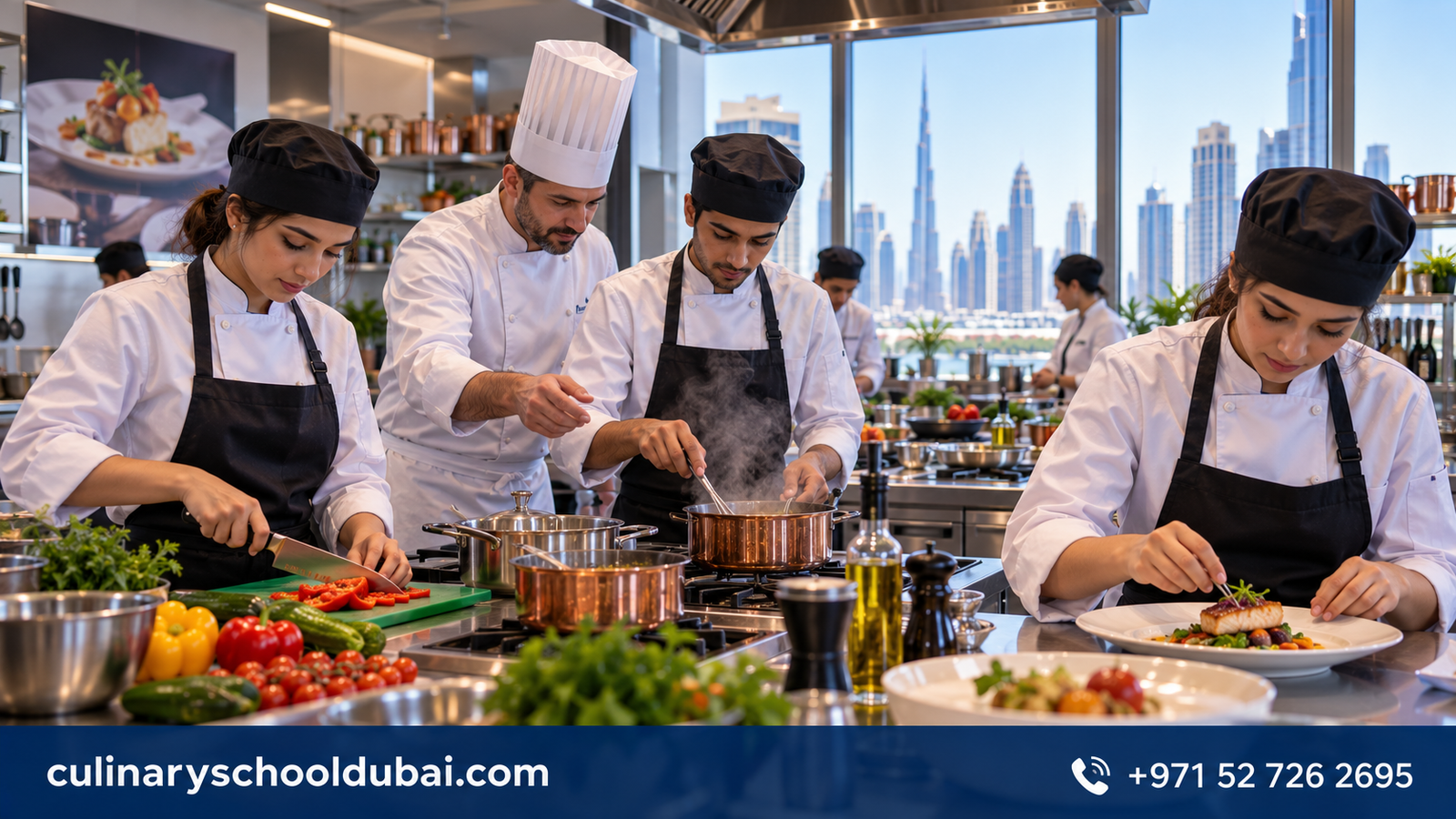
What Do You Learn in Culinary School?
If you enjoy cooking and want to develop professional kitchen skills, you may wonder, what do you learn in culinary school? Culinary education is about much more than learning individual recipes. A structured program teaches students the fundamentals of food preparation, cooking techniques, kitchen safety, food presentation, menu planning, and professional kitchen operations.
The culinary school curriculum can vary depending on the level and type of program. Beginner courses may focus on basic cooking skills, while advanced programs can introduce international cuisine, baking and pastry, menu development, kitchen management, and professional food presentation.
For students considering culinary training in Dubai, understanding the culinary course subjects Dubai programs offer can help them choose a course that matches their interests and career goals.
This guide explains the main topics commonly covered in culinary education, from the first knife skills lesson to practical kitchen training and professional food preparation.
What Is a Culinary School Curriculum?
A culinary school curriculum is a structured collection of subjects and practical lessons designed to teach students how to prepare, cook, present, and manage food professionally.
A comprehensive curriculum can include:
- Culinary fundamentals
- Knife skills
- Food preparation
- Cooking techniques
- Food safety
- Kitchen hygiene
- Baking and pastry
- International cuisine
- Menu planning
- Food presentation
- Plating
- Kitchen management
- Practical kitchen training
The exact subjects depend on the course level, duration, and training provider.
A strong program normally combines theory with hands-on practice so students can apply what they learn in a working kitchen environment.
Culinary Fundamentals
Culinary fundamentals Dubai training forms the foundation of professional cooking.
Before learning complex dishes, students need to understand basic ingredients, equipment, preparation methods, and cooking principles.
What Culinary Fundamentals Include
Students may learn about:
- Common kitchen equipment
- Cooking terminology
- Basic ingredients
- Herbs and spices
- Seasonings
- Measuring ingredients
- Mise en place
- Basic preparation methods
- Cooking temperatures
- Recipe organization
- Kitchen workflow
Mise en place, which means preparing and organizing ingredients before cooking, is particularly important in professional kitchens.
Students learn to organize their workstation, prepare ingredients, and plan the sequence of cooking tasks.

Knife Skills Training
Knife skills training Dubai is one of the most practical parts of culinary education.
Professional kitchens require chefs to handle knives safely and efficiently.
Students can learn:
- Proper knife grip
- Safe cutting techniques
- Basic knife maintenance
- Vegetable cutting
- Slicing
- Dicing
- Chopping
- Julienne
- Brunoise
- Mincing
- Cutting herbs
- Portioning ingredients
Knife skills are not only about speed. Accuracy, consistency, and safety are equally important.
Students gradually develop better control and learn how consistent cuts can improve cooking results and presentation.
Food Preparation Training
Food preparation training Dubai teaches students how to prepare ingredients before they are cooked or served.
This can include:
- Washing and preparing vegetables
- Preparing meat
- Preparing poultry
- Handling seafood
- Cleaning ingredients
- Measuring ingredients
- Preparing marinades
- Preparing sauces
- Preparing stocks
- Portioning
- Mise en place
Students also learn how preparation affects cooking time, texture, flavor, and presentation.
Good preparation helps professional kitchens operate efficiently, especially during busy service periods.
Cooking Techniques
Learning different cooking techniques Dubai is a central part of culinary training.
Students can be introduced to both dry-heat and moist-heat cooking methods.
Dry-Heat Cooking
These methods can include:
- Roasting
- Baking
- Grilling
- Broiling
- Sautéing
- Pan-frying
- Deep-frying
Moist-Heat Cooking
Students may learn:
- Boiling
- Simmering
- Poaching
- Steaming
- Blanching
Combination Cooking
Some dishes use more than one cooking method.
Examples can include:
- Braising
- Stewing
Understanding different techniques allows students to select the appropriate method for different ingredients and dishes.
Sauces, Stocks, and Soups
Sauces, stocks, and soups are important components of classical and modern cooking.
Students may learn how to prepare:
- Basic stocks
- Vegetable stocks
- Meat-based stocks
- Soups
- Cream-based soups
- Sauces
- Gravies
- Reductions
- Dressings
They learn how ingredients, heat, seasoning, and cooking time influence flavor and consistency.
These fundamentals can then be applied to a wide range of dishes.
Food Safety Training
Food safety training Dubai is an essential part of culinary education.
Professional food preparation requires careful attention to hygiene and safe food handling.
Students may learn about:
- Safe food storage
- Temperature control
- Cross-contamination
- Personal hygiene
- Safe handling of raw ingredients
- Cleaning procedures
- Food storage practices
- Basic food safety principles
The objective is to reduce food safety risks and encourage responsible kitchen practices.
Kitchen Hygiene Training
Kitchen hygiene training Dubai teaches students how to maintain a clean and organized food preparation environment.
Topics may include:
- Cleaning work surfaces
- Sanitizing equipment
- Washing utensils
- Personal cleanliness
- Safe waste disposal
- Proper food storage
- Maintaining clean workstations
- Cleaning schedules
Students learn that kitchen hygiene is part of professional cooking, not an activity performed only after service.
A clean workstation can also make food preparation more efficient.
Baking and Pastry Training
Many culinary programs include baking and pastry training Dubai.
Baking requires accuracy because ingredient ratios, temperatures, and cooking times can significantly affect the final result.
Students may learn:
- Bread preparation
- Cakes
- Cookies
- Pastries
- Tarts
- Pies
- Creams
- Fillings
- Basic dessert preparation
- Dough preparation
- Baking techniques
Depending on the course, advanced topics may include decoration and presentation.
Baking Skills
Students can also develop skills related to:
- Measuring ingredients accurately
- Mixing techniques
- Dough handling
- Proofing
- Oven control
- Temperature management
- Portioning
- Finishing
Baking training provides a different type of culinary discipline because precision is particularly important.
International Cuisine Training
International cuisine training Dubai introduces students to food traditions and cooking styles from different regions.
Depending on the curriculum, learners may explore cuisines such as:
- Italian
- French
- Mediterranean
- Asian
- Indian
- Middle Eastern
- American
- Continental cuisine
The objective is not simply to memorize recipes. Students can learn how ingredients, techniques, seasonings, and cultural traditions influence different cuisines.
Exploring Global Ingredients
Students may also become familiar with ingredients such as:
- Different herbs
- Spices
- Cheeses
- Grains
- Oils
- Sauces
- Specialty vegetables
- International condiments
This broader knowledge can help aspiring chefs become more adaptable in different kitchen environments.
Culinary Course Subjects in Dubai
The culinary course subjects Dubai students encounter can vary according to the program.
A comprehensive course may include:
- Culinary fundamentals
- Knife skills
- Food preparation
- Cooking methods
- Stocks and sauces
- Food safety
- Kitchen hygiene
- Baking and pastry
- International cuisine
- Menu planning
- Food presentation
- Plating
- Kitchen organization
- Kitchen management
- Practical culinary training
Beginner certificates may cover fewer subjects, while diploma-level programs can provide broader and deeper training.
Food Presentation Training
Cooking is only one part of professional food preparation. How a dish looks can also influence the dining experience.
Food presentation training Dubai introduces students to principles of visual presentation.
Students may learn about:
- Plate selection
- Portion placement
- Color balance
- Texture contrast
- Garnishing
- Height and structure
- Negative space
- Sauce presentation
The goal is to create dishes that look organized, appealing, and appropriate for the style of food being served.
Plating Techniques
Plating techniques Dubai training develops more detailed food presentation skills.
Students may practice:
- Centered plating
- Offset plating
- Layered presentation
- Sauce placement
- Garnishing
- Portion control
- Modern presentation
- Fine-dining presentation
Students can experiment with different layouts while learning how to maintain balance between presentation and practicality.
A visually attractive plate should still be easy to eat and should represent the dish appropriately.
Menu Planning Training
Menu planning training Dubai teaches students how to think beyond individual dishes.
A menu needs to consider factors such as:
- Type of restaurant
- Target customers
- Ingredients
- Seasonality
- Preparation time
- Kitchen capacity
- Food costs
- Variety
- Portion sizes
Students can learn how to organize dishes into balanced menus.
Menu Development
Menu planning can also involve considering:
- Starters
- Soups
- Salads
- Main courses
- Side dishes
- Desserts
- Beverages
The exact structure depends on the type of establishment.
Kitchen Management Training
Kitchen management training Dubai introduces students to the operational side of professional food service.
Cooking skills are important, but professional kitchens also require organization.
Students may learn about:
- Kitchen organization
- Workflow
- Mise en place planning
- Inventory
- Food storage
- Portion control
- Team communication
- Time management
- Basic cost control
- Kitchen safety
These skills can become increasingly important for learners who want to move toward supervisory or management responsibilities.
Time Management in the Kitchen
Professional kitchens can involve multiple orders and preparation tasks happening at the same time.
Culinary training can teach students to:
- Prioritize tasks
- Prepare ingredients in advance
- Organize workstations
- Monitor cooking times
- Coordinate multiple dishes
- Maintain cleanliness during service
Time management helps reduce unnecessary delays and supports smoother kitchen operations.
Food Cost and Portion Control
Some culinary programs introduce basic food cost concepts.
Students may learn why portion control matters and how ingredient usage can affect the cost of a dish.
Topics may include:
- Portion sizes
- Ingredient quantities
- Waste reduction
- Basic costing
- Ingredient utilization
- Menu pricing concepts
The depth of this subject depends on the course.
Understanding these principles can be useful for aspiring chefs who eventually want to participate in menu planning or kitchen management.
Culinary Training Modules Dubai
The culinary training modules Dubai programs offer can be arranged progressively.
A beginner-oriented structure might look like this:
Module 1: Kitchen Fundamentals
Introduction to equipment, ingredients, safety, and kitchen organization.
Module 2: Knife Skills
Safe and accurate cutting techniques.
Module 3: Food Preparation
Ingredient preparation, portioning, marinades, stocks, and sauces.
Module 4: Cooking Techniques
Dry, moist, and combination cooking methods.
Module 5: Food Safety and Hygiene
Safe food handling, storage, cleaning, and sanitation.
Module 6: Baking and Pastry
Basic breads, cakes, pastries, and desserts.
Module 7: International Cuisine
Cooking methods and dishes from different culinary traditions.
Module 8: Presentation and Plating
Presentation principles, garnishing, and plating techniques.
Module 9: Menu Planning
Creating balanced menus and understanding basic menu considerations.
Module 10: Kitchen Management
Workflow, organization, communication, and basic operational skills.
Module 11: Practical Kitchen Training
Applying the learned skills through hands-on cooking exercises.
The exact modules can differ depending on the training provider and course level.
Culinary Practical Training Dubai
Culinary practical training Dubai gives students the opportunity to apply theory in a kitchen environment.
Instead of only reading about cooking methods, learners can practice:
- Knife techniques
- Food preparation
- Cooking
- Baking
- Sauce preparation
- Plating
- Kitchen organization
- Hygiene procedures
Practical training also allows students to learn from mistakes and improve through repetition.
Why Hands-On Practice Matters
Cooking involves physical skills that develop through practice.
For example, reading about knife techniques cannot provide the same experience as actually holding and using a knife under instructor supervision.
The same applies to:
- Dough handling
- Sauce preparation
- Heat control
- Plating
- Portioning
- Kitchen workflow
Hands-on practice is therefore a major part of culinary education.
What Skills Can You Develop in Culinary School?
Culinary arts skills Dubai programs can help learners develop a broad range of technical and professional abilities.
These may include:
- Knife skills
- Ingredient preparation
- Cooking techniques
- Baking skills
- Sauce preparation
- Food safety
- Kitchen hygiene
- Plating
- Menu planning
- Time management
- Teamwork
- Kitchen organization
- Communication
The exact skills developed depend on the course and amount of practical training included.
What Equipment Do Culinary Students Learn to Use?
Students may become familiar with a variety of professional kitchen equipment.
This can include:
- Knives
- Cutting boards
- Ovens
- Stoves
- Mixers
- Blenders
- Food processors
- Grills
- Fryers
- Refrigeration equipment
- Measuring equipment
Students learn how to use equipment appropriately and safely.
Understanding equipment also helps learners work more efficiently during practical sessions.
Is Culinary School Only for Professional Chefs?
No. Culinary training can be useful for people with different goals.
Students may join culinary programs to:
- Start a culinary career
- Improve home cooking
- Develop professional kitchen skills
- Learn baking
- Explore international cuisine
- Prepare for hospitality work
- Build practical food preparation skills
The appropriate course level depends on the learner's objectives and previous experience.
Can Beginners Study Culinary Arts?
Yes. Many culinary programs are designed to introduce beginners to cooking fundamentals.
A beginner can start with:
- Kitchen safety
- Knife handling
- Ingredient preparation
- Basic cooking methods
- Food hygiene
- Simple recipes
- Basic presentation
As skills improve, learners can progress toward more complex techniques.
A beginner does not need to know advanced culinary techniques before starting an introductory program.
How Does Culinary Training Prepare You for a Professional Kitchen?
Professional kitchens require more than cooking ability.
Culinary education can help students understand:
- Kitchen discipline
- Hygiene
- Time management
- Mise en place
- Teamwork
- Communication
- Portion control
- Food presentation
- Consistent preparation
Students can practice completing several tasks while maintaining organization and cleanliness.
These habits can be valuable in restaurant, hotel, catering, and other food-service environments.
How to Choose a Culinary Course in Dubai
When comparing culinary programs, review the complete syllabus rather than looking only at the course title.
Consider whether the program includes:
- Culinary fundamentals
- Knife skills
- Cooking techniques
- Food safety
- Kitchen hygiene
- Baking and pastry
- International cuisine
- Menu planning
- Food presentation
- Plating
- Kitchen management
- Practical training
Also check the amount of hands-on training provided.
A program with practical kitchen sessions can give students more opportunities to apply what they learn.
Frequently Asked Questions
What do you learn in culinary school?
Students can learn culinary fundamentals, knife skills, food preparation, cooking methods, food safety, kitchen hygiene, baking, international cuisine, menu planning, plating, and kitchen management.
Do culinary courses teach knife skills?
Yes. Knife skills are commonly introduced as part of basic culinary training. Students can learn safe handling, cutting techniques, slicing, dicing, chopping, and other preparation methods.
Is food safety included in culinary training?
Food safety is an important part of professional culinary education. Students may learn safe food handling, storage, temperature control, hygiene, and cross-contamination prevention.
Do culinary schools teach baking?
Many culinary programs include baking and pastry subjects. The depth can range from basic breads, cakes, and pastries to more advanced pastry techniques.
Can beginners join culinary training?
Yes. Beginner courses can introduce students to kitchen fundamentals before progressing to more advanced cooking and presentation skills.
Is international cuisine part of culinary education?
Many programs introduce students to different international cuisines. The specific cuisines covered depend on the curriculum.
Do culinary courses teach plating?
Food presentation and plating may be included in culinary programs. Students can learn about portion placement, garnishing, balance, color, texture, and presentation techniques.
Is kitchen management taught in culinary school?
Some programs include kitchen management topics such as workflow, inventory, portion control, communication, organization, and basic cost management.
Final Thoughts
So, what do you learn in culinary school? A comprehensive culinary program can teach much more than recipes. Students can develop practical skills in food preparation, knife handling, cooking techniques, baking, food safety, kitchen hygiene, international cuisine, presentation, and plating.
More advanced programs may also introduce menu planning, food costing, kitchen organization, and management skills.
For anyone comparing culinary course subjects Dubai programs offer, reviewing the complete curriculum is important. Look for a balanced combination of foundational knowledge and culinary practical training Dubai so that you can apply techniques in a real kitchen environment.
Whether you are a complete beginner, an aspiring chef, a hospitality student, or someone who simply wants to strengthen professional cooking skills, culinary education can provide a structured way to develop your abilities.
The strongest learning experience combines knowledge, repetition, discipline, creativity, and hands-on practice. With consistent training, students can gradually move from basic food preparation to more advanced cooking, presentation, and kitchen-management skills.