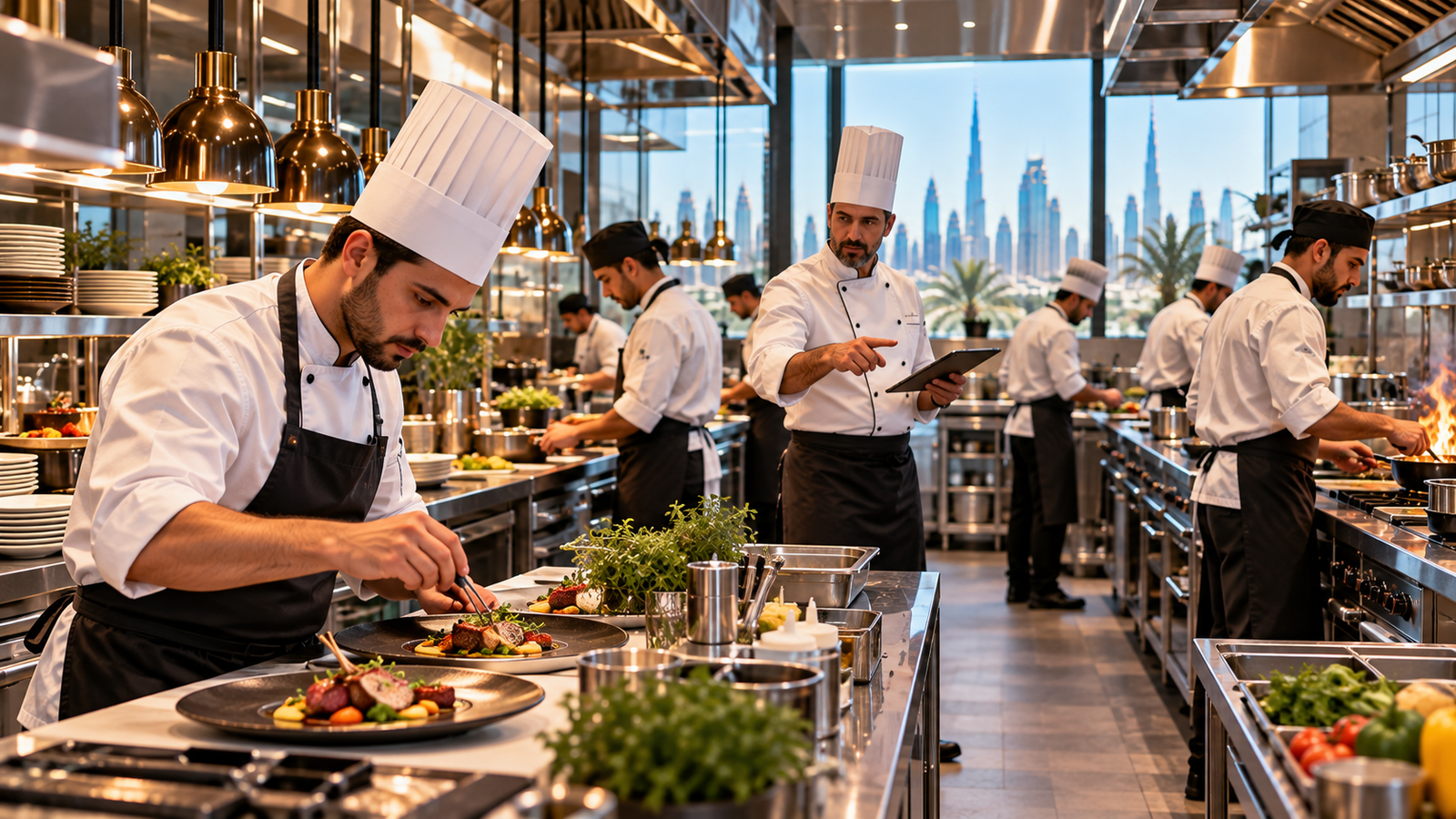
Sous Chef vs Executive Chef: Duties, Salary, Skills, and Career Path in Dubai
Introduction
A successful professional kitchen requires more than excellent cooking skills. It also needs effective leadership, organised operations, financial planning, consistent food quality, and a team that works together under pressure. In hotels, restaurants, resorts, and catering businesses, two senior positions play important roles in achieving these goals: the Sous Chef and the Executive Chef.
Although both positions involve kitchen management and culinary expertise, their responsibilities differ significantly. A Sous Chef usually oversees daily kitchen operations, supervises staff, coordinates food preparation, and supports the Head Chef or Executive Chef. An Executive Chef typically operates at a broader level, managing culinary strategy, menu direction, budgets, staffing, food quality, and overall kitchen performance.
Understanding the difference between a Sous Chef and an Executive Chef is particularly valuable for culinary professionals planning to advance their careers in Dubai and across the UAE.
This guide explains their responsibilities, qualifications, salaries, leadership skills, and career paths to help you understand what each position involves and how to progress towards senior culinary management.
What Is a Sous Chef?
A Sous Chef is a senior kitchen professional who assists the Head Chef or Executive Chef with managing kitchen operations. The title comes from French, where sous means “under,” reflecting the position's traditional place below the Head Chef.
The Sous Chef acts as an operational leader, helping ensure that food preparation, cooking, staff assignments, hygiene, and service run smoothly. Depending on the establishment, the Sous Chef may oversee several kitchen sections and take charge when the Head Chef is unavailable.
In a large hotel, a Sous Chef might coordinate multiple station chefs during a busy restaurant service. In a smaller restaurant, the same role may involve extensive hands-on cooking alongside staff supervision.
Sous Chef Duties and Responsibilities
The responsibilities of a Sous Chef combine culinary expertise with daily operational management.
- Supervising kitchen operations: Monitoring preparation, cooking, service, and the performance of kitchen stations.
- Managing kitchen staff: Assigning duties, coordinating shifts, supporting training, and maintaining professional standards.
- Maintaining food quality: Checking taste, presentation, portion sizes, consistency, and preparation methods.
- Supporting menu execution: Ensuring that chefs follow approved recipes, menu specifications, and culinary standards.
- Planning preparation: Making sure ingredients, equipment, and workstations are ready before service.
- Monitoring inventory: Checking stock levels, storage conditions, and ingredient rotation.
- Controlling food waste: Encouraging correct portioning, efficient ingredient use, and responsible preparation practices.
- Enforcing food safety: Monitoring hygiene, cleaning procedures, storage, and temperature control.
- Solving daily problems: Responding to service delays, equipment issues, ingredient shortages, and staffing challenges.
- Supporting the senior chef: Implementing instructions and helping achieve the kitchen's quality and financial objectives.
The Sous Chef must understand the kitchen's overall workflow while remaining close enough to daily operations to identify and resolve problems quickly.
Sous Chef Skills and Requirements
Employers commonly seek Sous Chefs with strong practical experience and the ability to lead a kitchen team.
Typical requirements include:
- A culinary arts qualification or equivalent professional experience.
- Several years of commercial kitchen experience, often including station leadership.
- Strong knowledge of cooking techniques and food presentation.
- Experience supervising and training junior chefs.
- Understanding of food safety and hygiene procedures.
- Knowledge of stock management, portion control, and food waste reduction.
- Good communication and time-management skills.
- Ability to make decisions under pressure.
- Experience maintaining quality during high-volume service.
The precise requirements vary by restaurant, hotel, cuisine, and level of responsibility.
What Is an Executive Chef?
An Executive Chef is a senior culinary leader responsible for the overall direction and performance of a kitchen operation or, in some organisations, several kitchens.
The role goes beyond supervising food preparation. Executive Chefs establish culinary standards, develop menus, manage budgets, oversee staffing, monitor food costs, and help ensure that the business delivers a consistent dining experience.
In a luxury hotel, an Executive Chef may oversee several restaurants, banquet kitchens, room service, staff dining, and other food production areas. In a smaller restaurant, the position may combine strategic responsibilities with direct involvement in cooking and service.
An Executive Chef often works closely with hotel management, restaurant managers, purchasing teams, finance departments, and other business functions.
Executive Chef Job Description
An Executive Chef's duties typically include the following:
- Culinary strategy: Establishing the overall food concept, culinary direction, and quality standards.
- Menu development: Designing menus, introducing new dishes, and reviewing recipes and seasonal offerings.
- Budget management: Preparing or managing kitchen budgets and monitoring expenditure.
- Food cost control: Reviewing ingredient costs, portion sizes, supplier prices, and food waste.
- Staff recruitment: Supporting hiring decisions, staffing structures, and workforce planning.
- Leadership and development: Training Sous Chefs, mentoring senior staff, and developing future kitchen leaders.
- Quality assurance: Maintaining consistent food quality and presentation across relevant kitchens.
- Supplier coordination: Working with purchasing teams and suppliers to maintain ingredient quality and availability.
- Food safety oversight: Ensuring that kitchen procedures meet applicable food safety and hygiene requirements.
- Business collaboration: Coordinating with management on events, promotions, guest expectations, and operational targets.
- Performance monitoring: Reviewing food costs, customer feedback, operational efficiency, and other relevant indicators.
An Executive Chef must balance creativity with financial responsibility. A successful menu should satisfy customers, reflect the establishment's identity, remain practical for the kitchen, and support the business's financial objectives.
Executive Chef Qualifications in the UAE
Executive Chef positions typically require extensive professional experience, strong leadership skills, and a track record of managing kitchen operations.
Common expectations include:
- A culinary qualification or equivalent professional experience.
- Extensive experience in professional kitchens.
- Previous experience in senior kitchen leadership, often as a Sous Chef or Head Chef.
- Strong menu-development and culinary planning skills.
- Knowledge of food costing, budgeting, purchasing, and inventory.
- Experience managing teams and developing staff.
- Understanding of food safety, quality assurance, and operational procedures.
- Strong communication, organisation, and decision-making abilities.
- Ability to manage performance, resolve complex problems, and work with senior management.
Luxury hotels and large hospitality groups may expect experience overseeing multiple outlets, banquet operations, or high-volume food production. Other employers may focus on expertise in a particular cuisine or restaurant concept.
Sous Chef vs Executive Chef: Key Differences
The main difference is the scope of responsibility. A Sous Chef concentrates on managing daily kitchen operations, while an Executive Chef generally oversees the wider culinary operation and its strategic and financial performance.
| ComparisonSous ChefExecutive Chef | ||
| Career level | Senior operational chef | Senior culinary leadership |
| Main focus | Daily kitchen operations | Overall culinary direction and performance |
| Reporting structure | Usually reports to Head Chef or Executive Chef | Reports to the relevant owner, general manager, or senior management |
| Staff management | Supervises kitchen teams and station chefs | Oversees senior chefs and broader staffing structures |
| Cooking involvement | Often directly involved in preparation and service | Varies; may focus more on leadership and planning |
| Menu responsibilities | Implements menus and may contribute ideas | Typically leads or approves menu direction |
| Budget responsibility | Helps monitor costs and waste | Often manages or oversees culinary budgets |
| Inventory | Monitors stock and coordinates requirements | Oversees broader purchasing and inventory strategy |
| Quality control | Checks daily production and service standards | Establishes and monitors overall culinary standards |
| Decision-making | Handles operational decisions within delegated authority | Makes broader culinary and management decisions |
| Business involvement | Supports operational objectives | Works with management on financial and strategic goals |
| Career progression | May advance to Head Chef or Executive Chef | May progress to corporate culinary leadership or other senior roles |
These responsibilities are typical rather than universal. Titles and reporting structures can vary across independent restaurants, hotel groups, and catering businesses.
Difference in Daily Work
Imagine a luxury hotel preparing breakfast, lunch, dinner, and a large evening banquet.
The Sous Chef may coordinate the kitchen teams, review preparation schedules, check food quality, reassign staff when necessary, and resolve delays during service.
The Executive Chef may review the banquet menu, assess food costs, coordinate with hotel management, approve staffing plans, monitor guest feedback, and ensure that all relevant kitchens follow the hotel's culinary standards.
Both positions contribute to the guest experience, but they approach the operation from different levels.

Difference in Leadership
A Sous Chef usually focuses on translating plans into daily action. They guide chefs, maintain service standards, and ensure that kitchen procedures are followed.
An Executive Chef must establish direction, set expectations, develop senior staff, and ensure that the operation meets culinary and business objectives.
This means that technical expertise alone is not enough for an Executive Chef. Financial understanding, long-term planning, communication, and people management become increasingly important.
Sous Chef Salary in Dubai
The salary of a Sous Chef in Dubai depends on the employer, kitchen size, experience, cuisine, and employment benefits.
For general career planning, an illustrative monthly salary range is AED 6,000–12,000. Some senior positions in luxury hotels or large hospitality operations may offer higher compensation, while smaller restaurants may offer less.
Factors that can affect salary include:
- Previous kitchen leadership experience.
- Experience in hotels, fine dining, or high-volume restaurants.
- Ability to supervise multiple stations.
- Knowledge of inventory, food costs, and kitchen operations.
- Specialised culinary skills.
- Accommodation, meals, transport, and other benefits.
Candidates should review the full employment package rather than focusing only on the basic monthly salary.
Executive Chef Salary in Dubai
Executive Chefs generally receive higher salaries than Sous Chefs because they may be responsible for broader culinary operations, budgets, senior staff, and overall performance.
For general planning, an illustrative monthly salary range is AED 12,000–25,000 or more, depending on the employer and the scale of responsibility. Compensation in major luxury hotels or large hospitality groups can vary substantially.
Key salary factors include:
- Size and complexity of the operation.
- Number of restaurants or kitchens under the chef's supervision.
- Experience managing senior culinary teams.
- Responsibility for budgets and food cost targets.
- Menu development and culinary reputation.
- Employer brand, benefits, and incentive arrangements.
These figures are indicative estimates, not verified current salary averages or guaranteed offers. Candidates should compare current vacancies and confirm compensation directly with employers.
Sous Chef vs Executive Chef Salary Comparison
| PositionIllustrative monthly salary | |
| Sous Chef | AED 6,000–12,000 |
| Executive Chef | AED 12,000–25,000+ |
The difference reflects the potentially greater financial and operational accountability of an Executive Chef. Actual salaries can overlap depending on the establishment and the responsibilities attached to each position.
Essential Leadership Skills for Senior Chefs
Moving from Sous Chef to Executive Chef requires a shift from primarily managing daily tasks to leading people, systems, and business performance.
Communication
Senior chefs must explain expectations clearly, communicate changes, and coordinate with teams across the kitchen and the wider business.
A Sous Chef needs clear communication during preparation and service. An Executive Chef also communicates culinary direction, financial objectives, and performance expectations to senior staff and management.
Staff Management and Development
A strong culinary leader builds an effective team. This involves recruitment, training, performance feedback, succession planning, and creating an environment where staff can improve.
An Executive Chef must develop Sous Chefs and other senior team members who can manage operations reliably.
Financial Awareness
Senior culinary professionals should understand food costs, portion control, waste, purchasing, and budget performance.
A Sous Chef often helps implement cost-control procedures. An Executive Chef may be accountable for broader financial targets and decisions affecting the entire operation.
Problem-Solving
Kitchens face unexpected challenges, from ingredient shortages to staffing problems and equipment failures.
Sous Chefs usually handle immediate operational issues. Executive Chefs must also consider longer-term solutions, resource allocation, and the impact of decisions on overall business performance.
Creativity and Commercial Thinking
An Executive Chef needs to develop appealing menus while considering customer demand, ingredient availability, preparation requirements, and profitability.
Creativity must be balanced with commercial realities. A popular dish is most valuable when it can be produced consistently and supports the establishment's goals.
Career Progression: From Sous Chef to Executive Chef
Progressing to Executive Chef generally requires a combination of technical excellence, leadership experience, operational knowledge, and financial responsibility.
Step 1: Strengthen Your Sous Chef Experience
Develop a detailed understanding of daily kitchen operations. Learn how to coordinate stations, maintain service standards, manage staff, and respond to operational problems.
Demonstrate that you can keep a kitchen running efficiently without constant direction from the Head Chef.
Step 2: Learn Budgeting and Food Cost Control
Study food costing, inventory management, purchasing, waste reduction, and budget monitoring.
Learn how ingredient prices, portion sizes, supplier decisions, and menu design influence profitability.
Step 3: Develop Senior Leadership Skills
Take responsibility for staff development, training plans, performance reviews, and team communication.
Practise delegating effectively instead of attempting to handle every task personally.
Step 4: Gain Menu Development Experience
Work with senior chefs to create new dishes, review seasonal menus, and evaluate guest feedback.
Understand how to balance culinary quality, preparation complexity, ingredient costs, and customer preferences.
Step 5: Take on Broader Operational Responsibilities
Seek opportunities to support banquet operations, special events, menu launches, staffing plans, or multiple kitchen sections.
This experience can demonstrate that you are ready to manage more than one station or a single daily service.
Step 6: Apply for Executive Chef Opportunities
Build a CV that highlights your leadership achievements, team size, operational responsibilities, cost-control experience, and menu-development contributions.
Prepare examples that demonstrate how you improved kitchen performance, developed staff, maintained quality, or addressed operational challenges.
Career progression is not automatic. Employers assess whether candidates have the experience and leadership ability required for the size and complexity of the operation.
How to Become an Executive Chef in Dubai
Dubai's hospitality sector offers opportunities across luxury hotels, resorts, restaurants, catering companies, and large food service operations. Candidates interested in senior culinary management should focus on developing both professional cooking skills and business knowledge.
Obtain Relevant Culinary Training
A culinary arts qualification can provide a foundation in cooking methods, kitchen organisation, food safety, and menu preparation.
Additional training in food costing, leadership, hospitality management, or business operations may be useful as your responsibilities increase.
Build Experience in Professional Kitchens
Gain practical experience in increasingly responsible positions. A common progression includes Commis Chef, Chef de Partie, Sous Chef, and then Executive Chef, although intermediate titles and routes vary by employer.
Focus on developing reliable technical skills and understanding how different kitchen sections operate.
Learn Kitchen Management
Study staffing, purchasing, inventory, food costs, quality assurance, and performance monitoring.
Executive Chefs need to understand how their decisions affect guest satisfaction, team performance, operational efficiency, and profitability.
Develop a Strong Professional Reputation
Maintain high standards, communicate professionally, and build positive working relationships with colleagues and managers.
A track record of reliable performance and effective leadership can strengthen your candidacy for senior roles.
Research Dubai Hospitality Employers
Explore opportunities with hotels, restaurant groups, resorts, and catering businesses. Review their job descriptions carefully because an Executive Chef in a single restaurant may have a different scope of responsibility from one overseeing multiple hotel outlets.
Tailor your application to the employer's needs and highlight relevant experience rather than relying on job titles alone.
Which Position Is Right for You?
Your ideal role depends on your experience, strengths, and long-term career goals.
Choose or continue as a Sous Chef if:
- You enjoy managing daily kitchen operations.
- You prefer hands-on involvement in food preparation and service.
- You want to develop leadership experience across several stations.
- You are building your skills in food costing and kitchen management.
Aim for an Executive Chef position if:
- You have extensive culinary and leadership experience.
- You can oversee senior staff and multiple kitchen operations.
- You understand budgeting, purchasing, menu development, and cost control.
- You are comfortable making broader operational and strategic decisions.
- You want to take responsibility for the overall culinary direction of an establishment.
A Sous Chef role can be an excellent foundation for senior management. However, progression should be based on demonstrated competence and the responsibilities you can manage, rather than years of service alone.
Conclusion
The difference between a Sous Chef and an Executive Chef lies in the scope of leadership and accountability. A Sous Chef oversees daily kitchen operations, coordinates food preparation, supervises staff, and supports the senior culinary leader. An Executive Chef typically directs the broader culinary operation, develops menus, manages budgets, oversees senior teams, and ensures that quality and business objectives are achieved.
Both positions require technical culinary knowledge, strong communication, and effective problem-solving. The Executive Chef role places greater emphasis on strategic planning, financial performance, and organisation-wide leadership.
For culinary professionals in Dubai, developing a combination of cooking expertise, staff management, menu development, and financial awareness can create a strong foundation for advancement. By gaining practical experience and gradually accepting broader responsibilities, aspiring chefs can work towards successful careers in senior culinary management.
Frequently Asked Questions (FAQs)
1. Is an Executive Chef higher than a Sous Chef?
Yes. In a typical kitchen hierarchy, an Executive Chef holds a more senior position and is responsible for the overall culinary operation, while the Sous Chef manages daily operations and supports the senior culinary leader.
2. What is the main difference between a Sous Chef and an Executive Chef?
A Sous Chef focuses on kitchen supervision, service coordination, and staff management. An Executive Chef focuses on overall culinary direction, menu development, budgets, senior leadership, and operational performance.
3. What is the salary of a Sous Chef in Dubai?
An illustrative planning range is AED 6,000–12,000 per month. Actual compensation depends on experience, employer, responsibilities, and benefits.
4. What is the salary of an Executive Chef in Dubai?
An illustrative planning range is AED 12,000–25,000 or more per month. Salaries vary according to the scale of the operation, employer, experience, and benefits.
5. How many years of experience are required to become an Executive Chef?
There is no universal requirement. Executive Chef positions generally expect extensive kitchen experience, proven leadership, and a track record of managing culinary operations. Requirements vary by employer.
6. Do Executive Chefs need a culinary arts qualification?
Many employers prefer formal culinary training or equivalent professional experience. Leadership ability, operational knowledge, and practical results are also important.
7. Can a Sous Chef become an Executive Chef?
Yes. A Sous Chef can progress by developing broader management skills, gaining menu-development experience, learning financial controls, and demonstrating the ability to lead an entire culinary operation.
8. What skills are most important for an Executive Chef?
Key skills include leadership, communication, menu development, budgeting, food cost control, staff development, food safety, decision-making, and the ability to maintain consistent culinary standards.